What woodworm actually is
"Woodworm" is the larva of a wood-boring beetle. The one found most often in UK houses is the common furniture beetle. The larvae feed inside the timber for years, commonly put at around three, and sometimes up to five. When they mature the adult beetles chew their way out, mostly in late spring and summer, and that is what leaves the holes.
The signs to look for
- Round flight holes. Common furniture beetle holes are tiny, about 1 to 2mm across. Holes of around 3mm usually point to a different beetle, which matters because the treatment and the risk to the timber can differ.
- Fine, gritty dust (bore dust, or frass) under or around the holes. Fresh, pale dust is the clearest sign of activity.
- Timber that crumbles or gives way when you press it with a screwdriver, with a thin sound shell and a soft inside.
- Damaged edges on floorboards, stair strings, joists and roof timbers, usually where the wood is slightly damp.
- Dead beetles on windowsills or on the floor beneath timbers in summer.
Old holes or an active infestation?
Holes that are dusty, dirty or painted over are often from an infestation that finished years ago. Fresh holes with clean wood showing at the edge, and fresh dust beneath, mean the beetles are active. Because the beetles only emerge for part of the year, the summer is when activity is easiest to see, so it is worth checking again then if you are unsure. Where there is any doubt, a survey is the way to find out, because treating timber that does not need it is wasted money and leaving active woodworm is a slow, hidden loss of strength.
Woodworm, wet rot and dry rot are different things
Woodworm is an insect. Wet rot and dry rot are fungi. Rot needs moisture to take hold, and timber that is damp enough for rot is also more attractive to beetles. If there is decay as well as holes, the damp that caused it has to be found and fixed or the timber will go again. That is why timber treatment and damp work are usually looked at together.
What treatment involves
Treatment is normally a contact insecticide, sprayed or brushed onto the exposed timber and injected into the flight holes. Because the product acts on beetles and larvae that come into contact with it, the whole of the affected timber is treated rather than only the holes you can see. Timber that has lost its strength is cut out and replaced rather than treated. Afterwards the cause of the damp, if there was one, is dealt with so the problem does not return.
Where it turns up locally
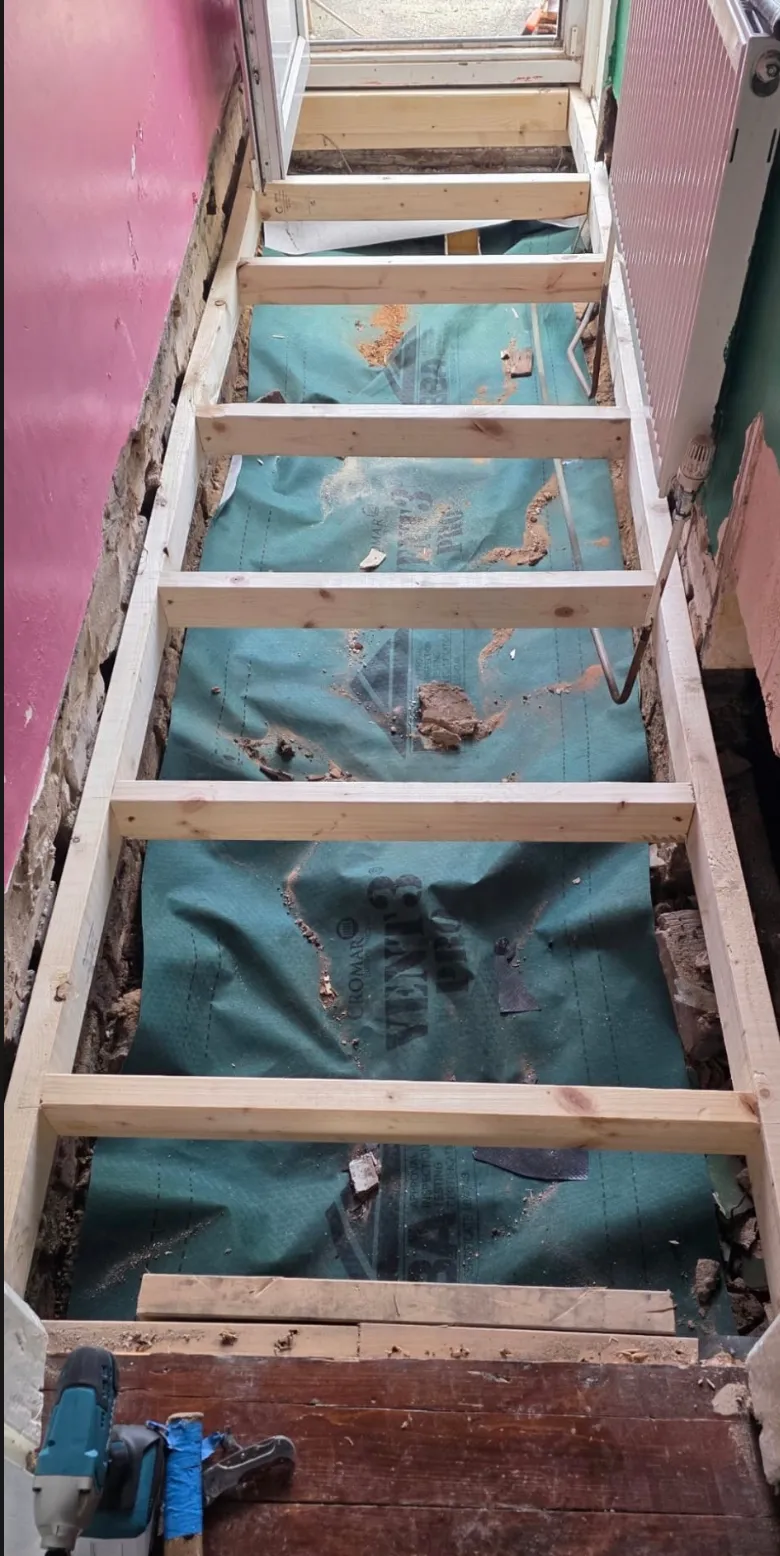
Woodworm is found in the timber of older houses everywhere, and the places we are called to are the same on the Wirral, in Liverpool and around Wrexham: floorboards and joists over a damp or poorly ventilated void, stair timbers, and roof timbers in older properties. Heswall and the west Wirral have many older houses built from the local red sandstone, with timber floors and roofs behind thick walls, and the Victorian terraces of Birkenhead, Liverpool and Wrexham have timber ground floors that sit over a ventilated void. Where that void or the walls around it are damp, the timber above it is at more risk.